Monday, January 4, 2016

The Mother of All Trash-Treasures

I have written before (here and here, for example) about my passion for trash both on a professional level (what it reveals about a culture's values) and on a personal level (treasure-hunting memories with my dad!).  Today I shall report specifically on furniture treasures -- and the best trash EVER.

In some ways, the Korean trash system is far superior to what I've seen in the US.  Here, thanks to a 20-year-old national law, folks pay for their trash by weight/size via special trash bags available at any grocery or convenience store. This approach strongly encourages people to recycle and to put food scraps in designated bins outside every residential building.  In other ways, though, Korea is a far more wasteful society then the US because there is virtually no consumer market for used items (#missingGoodwill).  Perhaps this is because secondhand items are a sensitive reminder of post-war poverty and famine.  Add to that some a Confusion/Buddhist value system that frowns on taking things from one’s “dirty” home to a new/clean one, and you get a LOT of perfectly good furniture piling up (note: you have to buy trash stickers for these items, but it's only a few bucks).

True, it's pretty shameful in Korea (even more than in the US) to hunt through the trash (except for elderly box-collectors, who roam the streets with overloaded carts to make a little money selling cardboard to scrapyards).  Even so, my beloved TA's reaction to my particular hobby  (despite her support of all things green and vegan)  was telling.  When I suddenly pulled our van to the edge of the road and hopped out to grab a lovely wooden picture frame, she was stunned (of the full mouth-hanging-open kind).  “Professor!!!”  she breathlessly exclaimed, with eyes very wide.  I felt my father’s grin steal over my face, and I made a great bulletin board out of that frame that hangs in my bedroom.

To be sure, most modern Korean furniture is made of pressed sawdust and plastic laminate (faux wood grain), which is pretty horrible (but it "looks Western" which in Korea means "good").  I have quickly learned that such dreck is not worth salvaging.  But despite the heaps of cheap furnishings, I have found worthwhile stuff to use, sell, or give away.  Here are some recent examples:

Elisabeth and I found a lovely wooden dresser
to replace David's plastic one. After watching us
struggle for awhile to lift this monster, a Korean man (out for a smoke break)
took pity on us and helped load it into the van.  :) 

Huge framed art for the 5th floor hallway! A very traditional Korean work with trees and a tiny
Buddhist temple tucked into the mountainside.

Some western-style Art for the lobby.
And lovely found pots grow bamboo in our hallway.

And a giant kimchi pot - it was cracked and no longer useful for fermenting.
But for Christmas decorating in our building's lobby?  Perfect.
So we've found lots of good things we can resuse or pass on to others.  But last week -- oh the bliss! -- we found the Mother of all Treasures. These three Korean antiques date from the post-war period (1950-1960s) and feature elaborate, hand-crafted mother-of-pearl (abalone) designs inlaid in black lacquered wood.  We saw the mirror and vanity/dressing table first, when we got out of the van to visit friends in a nearby high-rise.  I forced our family back to the trash pile and made them help load it into the van.  Then I spotted a matching pair of  bridal chests  Oh my heart!  Nick and friend Josh nicely drove the mirror/vanity back to our place and then returned to load up the two chests.  Even the kids didn't complain about being rather squished on our drive home and now we LOVE THEM (the furniture, I mean.  Not the kids.  Oh, wait, yes - I love them too, of course).

Here they are.  

Black lacquer mirror and vanity stand with inlaid mother-of-pearl. 
Vintage Korean furniture 40+ years old.
I found it in the trash. 

A pair of black lacquer vintage Korean mother-of-pearl (abalone) inlaid bridal chest.
We're using them as coffee tables and storage.
Did I mention that we found these in the trash?

Detail of a chest door; I love the subtle color variations
in this thumb-sized bird and can't imagine the patience it
took to create even this little section..

Detail: knob on the table/bridal chest


Birds and forest animals are the primary themes on these pieces.

Did we win the Dumpster Find of the Year or WHAT??  Oh, yeah.  I win.  I'm the dumpster MASTER! :)

Monday, December 28, 2015

News Bombs: Inscrutable Korea

I read a daily Korean newspaper (it’s in English) and it’s been an excellent way to learn about Korean culture/structures/values.  It can also be hilarious, at least to an American who cannot understand what these people are thinking.  Two recent articles have stood out in this way.

(1)   Korea-Japan relations (or, Revenge with Poo).


Korea and Japan are not good friends, visible through such things as the astonishing lack of Toyotas or Hondas driven here (it would be like Ohio having no cars from GM or Ford.  Weird).  This “frenemy” situation has undoubtedly arisen because Japan invaded our fair peninsula a few times over the last several hundred years and made life hell for the locals.  Despite the good behavior of Japan since 1950 or so, this historic bitterness is still worthy of current news, whether about now-elderly “comfort women” (young women who were used for military sexual services in WWII), what to call the body of water between our nations (the map above is WRONG), or to what extent Korean history textbooks should acknowledge the shady dealings of Koreans themselves during the 20th century Japanese occupation. 

Another common news item along these lines concerns Japanese officials visiting the Yasukuni Shrine in Tokyo and what that might mean for Korean-Japan relations (because in Asia, if you can possibly read into something, you most certainly should).  The Yasukuni shrine is believed by many Japanese people to be the current home of over 2 million souls who gave their lives for the Empire. This includes 1000ish convicted war criminals and even includes some men convicted of Class A crimes against humanity. This is a rough crowd of dead people.  So, whenever a Japanese prime minister or other government dignitary visits the shrine, many Koreans read this as “jabs a chopstick in the eyes of Koreans everywhere.” (See here for more on Yasukuni shrine controversy.)

So there's your backstory.  In November, someone detonated a bomb at the shrine and a Korean man was suspected (no surprise there). Later articles revealed that the “bomb” was more like a high-class firecracker.  And that it had been detonated in a men’s bathroom on the shrine’s grounds rather than at the actual shrine.  And that no one (neither dead nor alive) was actually hurt and virtually no building damage was done.  Thus, one might think this was not necessarily worthy of national news in Korea.  But let me continue.  The suspect escaped Japan and returned home to Korea, but then upon learning that his CCTV photo was splashed all over the Japanese news, he went back to Japan to see what the fuss was about, and got himself arrested.  We are not dealing with a top-of-the-class mind here, folks.

But it doesn’t end there. Outside a Korean consular office in Japan last week, workers found a box.  With an attached ominous note signed by a very conservative (read: anti-Korean) group along the lines of “here’s payback for the shrine bombing.”  The local bomb squad was immediately called and they carefully did bomb-squad stuff, which eventually led to the actual opening of the box which led to a terrible smell…of poop.  It was not a bomb.  It was a box of dried poop.  (Whether human or animal was not known at press time.)  POOP, people! How a poop delivery fairly retaliates for a smoke bomb is well beyond my ability to understand. 

(2)   Military Commemoration: When Art Misses the Mark.

In August, two South Korean soldiers doing foot patrol along the demilitarized zone (our border with North Korea) stepped on land mines, which resulted in three of their combined 4 legs being violently removed.  Of course, suspect #1 was North Korea, and the two countries were closer to resuming war than they had been in years (the Korean War was never won or lost, you might remember, which means the delicate truce gets threatened all the time by things like whose boats were too close to whose islands and who floated propaganda over whose border in big balloons). 

Anyway.  This week's news featured a ceremonial unveiling of artwork meant to honor these brave-but-amputated soldiers.  One can imagine the thought that would go into such an important statement and the careful consideration of design and meaning.  The resulting sculpture, commemorating the soldiers' sacrifice and a physical symbol of the ongoing process of reunifying the torn Korean peninsula is (drum roll here)… a severed leg.  A human leg.  And, perhaps even worse in the “You have to be joking" category, this $200,000 bronze sculpture is called… “The Foot of Peace”  Really.  I would not, could not, make this up.  Just imagine the t-shirts that the soldiers could sell during DMZ tours: “I got my leg(s) blown off and all I got was a memorial to peace (piece!) in the form of a severed human leg.”  Oh, the photo opportunities this will provide for generations of Koreans with their selfie-sticks. 

photo credit: http://koreabizwire.com/amputee-sergeant-walks-again-as-a-sculpture/47299

Am I too hard on this little country that came from abject poverty to fastest-internet-on-the-planet in just 50 years?  Perhaps I am.  On the other hand, in a world of terrorism and school shootings and Donald Trump, it’s kind of nice to live in a land where poop and foot-statues are important things to report.   


Sunday, November 29, 2015

Korean Socks & Bathroom Humor

For today's essay, dear readers, we shall examine how Korean socks illustrate a key difference between Korean culture and that of America.  

In the US, we value quick humor (witty come-backs, sarcasm) and other signs of apparent sophistication  (e.g., 8th grade boys won't sing during school choir concerts). Americans also talk about sex.  All. The. Time.  Which I didn't realize until I moved away.  Any common noun or sentence can be (and usually is) turned into not-so-sly references for particular body parts (especially male) or The Office-inspired “that’s what she said” quips.

Koreans, however, prefer cuteness over sophistication.  Thus, major cities boast cartoonish mascots; elderly people and barely-walking children know the standard cute photo "poses"(e.g., V-signs by the chin, making heart shapes with arms or curled fingers).  Grown men can wear pink socks and business women can wear a Hello Kitty barrette and no one blinks.  Cute is in.

A smoking dragon (?).  Why? I don't know.
Now to Korean socks, which are easily found in any convenience store or grocery store for about $0.90 per pair. They are unfailingly cute but otherwise demonstrate a remarkable variety of images: hearts, mustaches, flags, ducks, Batman, hamburgers, etc.  I even have a pair with Obama’s face (thank you, Evie!).  And I cannot resist collecting them (as gifts, I tell myself). It’s kind of refreshing to live in a place of such apparent innocence, where sexuality is very private and childlike wonder is encouraged. However, as I've mentioned before, Koreans are far more "free" about bathroom functions than are Americans. And thus, socks + poop humor = cuteness in Korea.

I bought the socks pictured below just in the last month in three places (grocery store, “dollar" store, and campus snack store).  Let's take a look at what they tell us.


This poop is apparently horrified by its own smell.
(the caption says "Poop Smell").


Here we have a boy with a runny nose and a poop hat eating a poop candy.
Just imagine wearing these to work. Or on a date.  Or pretty much anywhere, ever.

And today's purchase: A panda (?) peeing under the caption "Whatta YOU lookin' at?!
With red lips for a butt.  

I still don't understand a lot of Korean culture.  But in the meantime, it sure is funny.  ;)

Wednesday, November 11, 2015

Building a Future: Making Compost

Here you see bits of 4 gardens.
When I lived in the faraway Land of Mighty Topsoil (Iowa), I had no idea how lucky I was. That soil just GREW stuff --with virtually no effort on my part! I often enjoyed coming home from work and spending "alone time" moving plants or pulling weeds or cutting flowers. But now....  Now I live in an apartment atop a gravelly Korean mountain. I have a garden, but it's not the same.

Long-time readers may recall earlier garden reports (for example, see here).  You may also recall the varied antics of Australian friend Tracey (here). Today's post joins these happy topics in a fall report.

A few weeks ago, Tracey noticed the roadside leaf sweeping of campus ajummas.
Hmmm.... she said.   A project, she said.  I'll call Sherri, she said.

So a project was planned.  With her unmatched persistence (and a translator), Tracey scored the bagged leaves,
which we pick up Monday and Wednesday mornings.
And, yes, that is a twig broom  - which makes the PERFECT swishing sound.

Today was Wednesday. This is Bag Stop #1. 

We piled the bags into my van (today's haul broke our record: 15 bags!) and drove them
up the forested path to the garden.
This is a sneak photo of Tracey, who hates having her picture taken. 
Google research shows that a ratio of 4 bags of leaves per bag of horse manure is about right for rapid breakdown into Soil from Heaven.  Thus, we periodically travel to the horse stables, which is a short walk down the mountain but a significant drive off campus, through a local village, through winding rice roads, and up a steep pseudo-trail at which someone in years past has tossed wheelbarrows of moist concrete. We have been to the stables enough that even the guard dogs don't bother barking.  A couple of weeks ago, the owner and his friend invited us into the office (it's as nice a word as I can think of for the place) to have coffee.  Of course, we lacked a common language, so we resorted to lots of awkward gestures and pointing, and sipping (I don't like coffee; Assertive Tracey asked for water on my behalf.  And... I was given the honor of being served barley water, which is like strained river water).  Of course, at the END of the longest 20 minutes of my life, the friend decided that chatting in English would be just fine after all.

Setting up for manure collection.  The stable owner offered us use of his clever hand-made stand (of welded re-rod) that
perfectly holds the plastic "burlap" feed bags they give us for collecting manure.
We laugh every time: we visit this place: American and Australian women bagging horse poo from a rural Korean stable.  
I admit to shaming Tracey into this picture.  For your mom, I said.  She will be proud, I said.

And guess who stole my camera when I was busy shoveling....  One for your mom!  she cried.   

11 bags of fresh poo later, we drive quickly back to campus with all the windows open,
trying to swish the flies and stink away, hoping the odor leaves before we take students to church on Sunday.
Leaves, manure, more leaves....  Stop often for coffee and stories.   


Now, "coffee time" in Tracey language means "Let us sit comfortably and slowly sip our drinks and catch up on our lives and not return to our labors until the very last possible drop is a bare memory.  And maybe not even then for it is such a lovely day."  To a Brit (or Australian), "morning tea" and "afternoon tea" are events.  One plans for them and works one's schedule right around them.  In my mind, task-oriented American that I am, coffee = 2 minutes to wipe off dripping sweat and glug something down before continuing to work.  And to think that I once prayed for opportunities to learn patience.

W'e have filled both bins, which are made from pallets gleaned from the campus garbage bin.
We take a perverse delight in plunging our arms into the piles to detect the heat of decomposition.
When the bins were full, we started a free-range pile, layering and watering and turning.  I spied some discarded
fencing this morning, which might be pressed into service as another compost bin.


Each day we head home, trying to walk with dignity in compost-speckled clothes among our stylish neighbors. who wonder about our work. This is not Iowa, with foolproof gardens guaranteed to bloom, but together here in Korea we're building warm winter hope.

Wednesday, November 4, 2015

Taipei Finale: Snippets

I see that I never quite finished our family vacation to Taiwan last January. So here are some final snippets.

Quick scene: She squatted, face down, just outside the labyrinth of airline passengers waiting for boarding passes.  The woman, wearing a wide-brimmed hat and a long, dark, star-spangled coat, waited for her (apparent) husband to reach the ticket counter,where she quickly moved to join him. We wondered how it was possible for the airline agent to match her passport photo to the face hidden under all the plastic surgeon’s bandages.

A panoramic view of Liberty Plaza, with memorials for former Taiwan leader Chaing Kai Shek.

The stately buildings around Liberty Plaza were populated with small groups of students
practicing dances and doing other arts.  No adults were apparent.

Our Park City Hotel room featured a large picture window between the bedroom and bathroom.
Nick is pictured in the bathroom here; Elisabeth and I are reflected in the window.  Very glad there was a shade.

This cart with plastic greeters warmly welcomed us to the hotel's elevator lobby.

Lovely painted details; similar colors as Korean temple but a different style.


Giant plastic reindeer on a see-saw.  Call it art.

Taiwanese money is gorgeous.
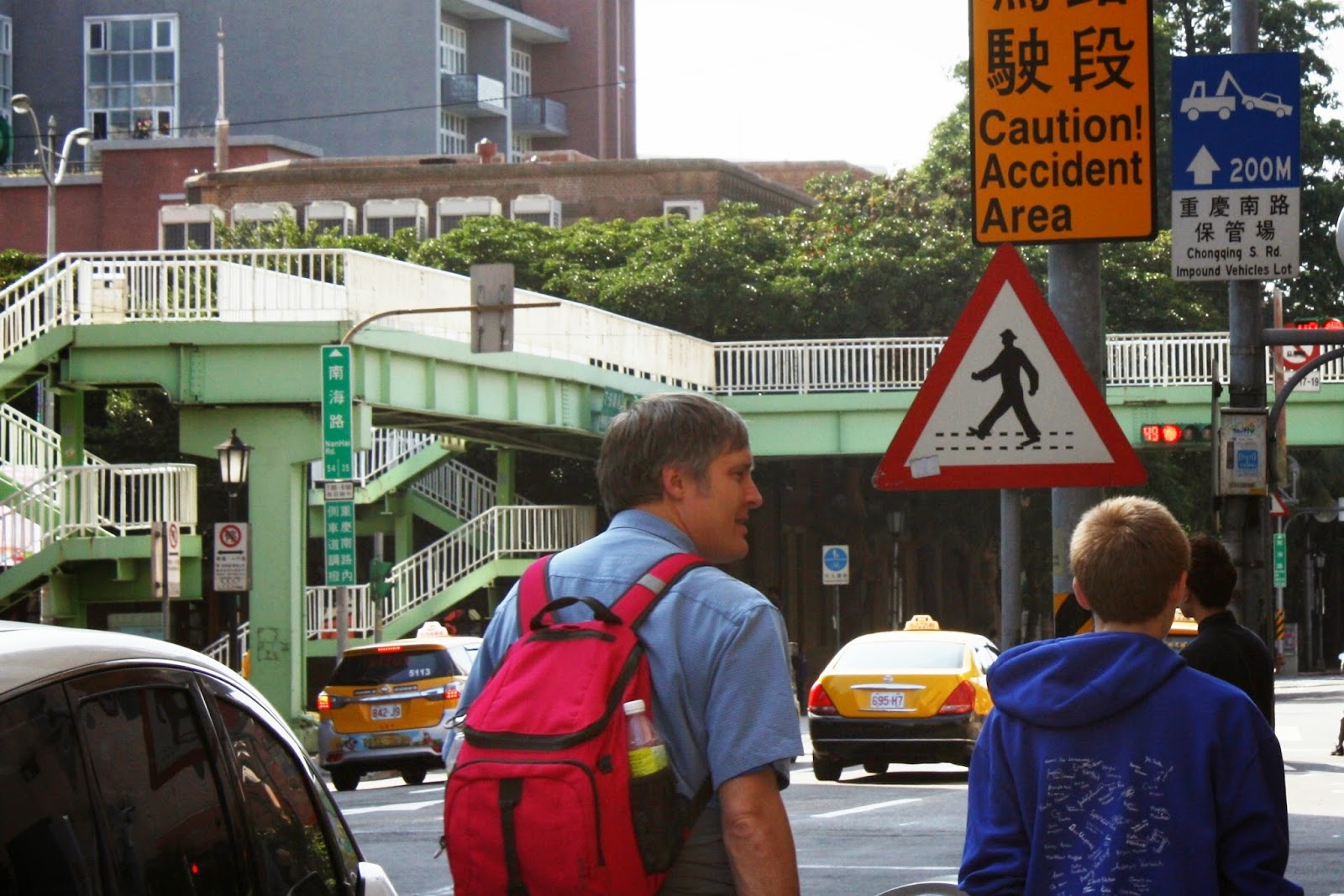
Watch out for accidents! 

That is one creepy face.  And really old artwork.

Funny Place Names: How to Get Teenagers to Read Map.  
Lovely black sand castles.  In January.  

We dug faster than this sand crab and got his picture as a reward.  


Even tiny villages had elaborate temples.  This one also had a modern, scrolling text sign above its door .

Now that we've visited Taiwan, I have officially been to 4% of the countries in the world (Nick scores in the 22% range). Look at your own map here: http://www.travbuddy.com/maps/6821483.  :)


Peeing & Privacy: Cross-Cultural Observations

Peeing is an important function.  As an American woman, I see it as an important and private function. But, alas, Korea has repeatedly revealed some other ideas about peeing. Here are three observations.

(1) Latrine Layout: This applies to men's restrooms only.  First, when there are doors to the hwa-jahng-sheel (literally, toilet room), they are rarely closed.  Second, the urinals are typically located exactly across from doorway rather than coyly tucked around the corner.  Which, together, means that regular people, who might be waiting for the elevator before class, can far too easily observe students and colleagues ... using the facilities.  Too much information.
Here is the elevator.  And the restrooms to the right.
Oh.  Wait.  Is that the men's restroom that I see?

Yes.  Yes it is.

(2) Roadside Relief: Korean men pee in public. Yes, I know that many American men enjoy taking a whiz off any available bridge or cliff; I understand that many an American on a long drive has made furtive roadside pitstops in grassy ditches.  BUT.  Here, men appear comfortable gladdening their bladders along the walls adjoining city sidewalks or standing on the road's shoulder.  This weekend, while waiting at a family amusement park (more on that in a future post), a man in front of us stepped out of line, stood next to a tree about 10 feet away, and let loose while facing us.  Perhaps he had some intellectual impairment.  I don't know. I, perhaps trying too hard to normalize this awkward situation, chose to use it as an opportunity to inform our children about cultural differences in circumcision decisions.  This is possibly more than you wanted to know.  And quite certainly more than they wanted to know.

(3) The Medical Pee:  Professors and staff (probably anyone under the government health plan) are required to get annual physicals; these are free.  And, as a lovely courtesy, the university invited a local hospital to bring their services to campus this week.  Medical stuff is pretty similar in any developed country, right?  Ah, no.

Let's take just a moment to review a stereotypical American system of urine specimen collection.

(a) Patient is called from the general waiting room to a more private medical area.
(b) Patient is given a plastic, sterile cup with screw-top lid. Cup is labeled with identifying information.
(c) Patient slips into a nearby restroom.  Lots of handwashing and wipes are involved in a "clean catch" procedure.  The collected specimen is tightly sealed in sterile cup.  More handwashing follows.
(d) Patient discretely carries the sealed specimen to a nearby nurse (acting as casually as possible to counteract embarrassment), or can leave it in the restroom for magic fairies to complete the testing and disposal process.

The American system can be a little awkward, but it's manageable.  And private. Pee is private.

Back to Korea. Now, I realize that this particular bizarro world of hospital-meets-classroom may not be typical. But I suspect it is.  Which my beloved TA confirmed. Ok, here goes.

The scene:  A designated classroom in the very center of the main academic building. A long table was set up at the open door, allowing interested passers-by to hear and observe one's medical business.  The table was staffed with two students (serving as translator-gophers) and three nurses.

The Room and Long Table.

The process: Hand in completed forms to Nurse #1. She confirms professor's name on a list and gives him/her a white paper Dixie cup to take to the hwa-jahng-sheel.  (Wait -- what?  Student-gopher translates.)  The restroom is located at the end of the long hallway.  Past numerous deans and administrative offices and classrooms. A gauntlet of shame.

The long, long hallway to the restroom.
The horror: Take the not-sterile, non-lidded cup to the restroom, complete a non-clean-catch, and restore one's clothing while carefully balancing a very squishy and warm paper cup.  Now return down the long hallway, past all kinds of people who hold one's career in their hands, while carrying said warm squishy cup that trails a certain aroma.

And more horror: Wait in line for those who are exchanging their forms for a paper cup; try to ignore the waiting people seating just a few feet away.  Offer cup of humiliation to Nurse Pee.  She does not take it. No indeed. Instead, she dips a test strip into the cup, shakes, and tapes it to your form.  You, then, are left holding the remaining specimen.  In a now-very-squishy, smelly vessel. Wondering at your apparent stupidity, Nurse Pee, through the student translator, gives terse directions: pour the urine into the can/pot by your feet then put the empty cup in the unlidded trash box next to it.


I took this picture on my phone - it is NOT zoomed in - from the "waiting area."
And it has the added bonus of an adorable English misspelling.   
The best part of living abroad is the opportunity to learn new ideas and ways of life.  The worst part of living abroad is being wrong (and humiliated) so often.  I often comfort myself by thinking "Oh, well, that nurse/bus driver/ajumma/gas station attendant will now have a good story to tell at dinner tonight."  At least I can serve as cheap entertainment.  Ah....