Monday, June 9, 2014

Spirit Week: Sports Day and Festival


More Spirit Week activities at David and Elisabeth's school.  For Sports Day, each middle-and high-school student was assigned to either the Red or the Blue team (and for $15 each got a nice knock-off soccer uniform in the corresponding color). I was surprised that even these randomized teams got pretty competitive with each. Happily, David and Elisabeth were on opposite teams so it was fun to see them compete.  Fun for me, at least. :)


David and Elisabeth's personalities are obvious on the basketball court:
Elisabeth doesn't care as much about the game but has a rather offense-oriented style;
David cares deeply about the game but is more of a natural defense guy.
(Low picture quality due to pre-telephoto shots from our 5th floor balcony.)
Waiting for middle-school baseball to begin, David intently watches the high school game
while Elisabeth messes around with friends (Josie V is here for a month from Grand Rapids
--and in a near-impossible coincidence, is great friends with Elisabeth's closest cousin.)
Middle-school baseball, where David and Elisabeth's teams played each other.
David had some nice hits and his team's first run (of 2).
Elisabeth seemed to enjoy people watching, though she had a fantastic catch/throw.

Elisabeth volunteered for the 40-on-40 tug-of-war and was right near the front line.  She's not shy, folks.

(For about 10 other pictures of the day, including 2 of David, see Aleksey Yoo's site.)

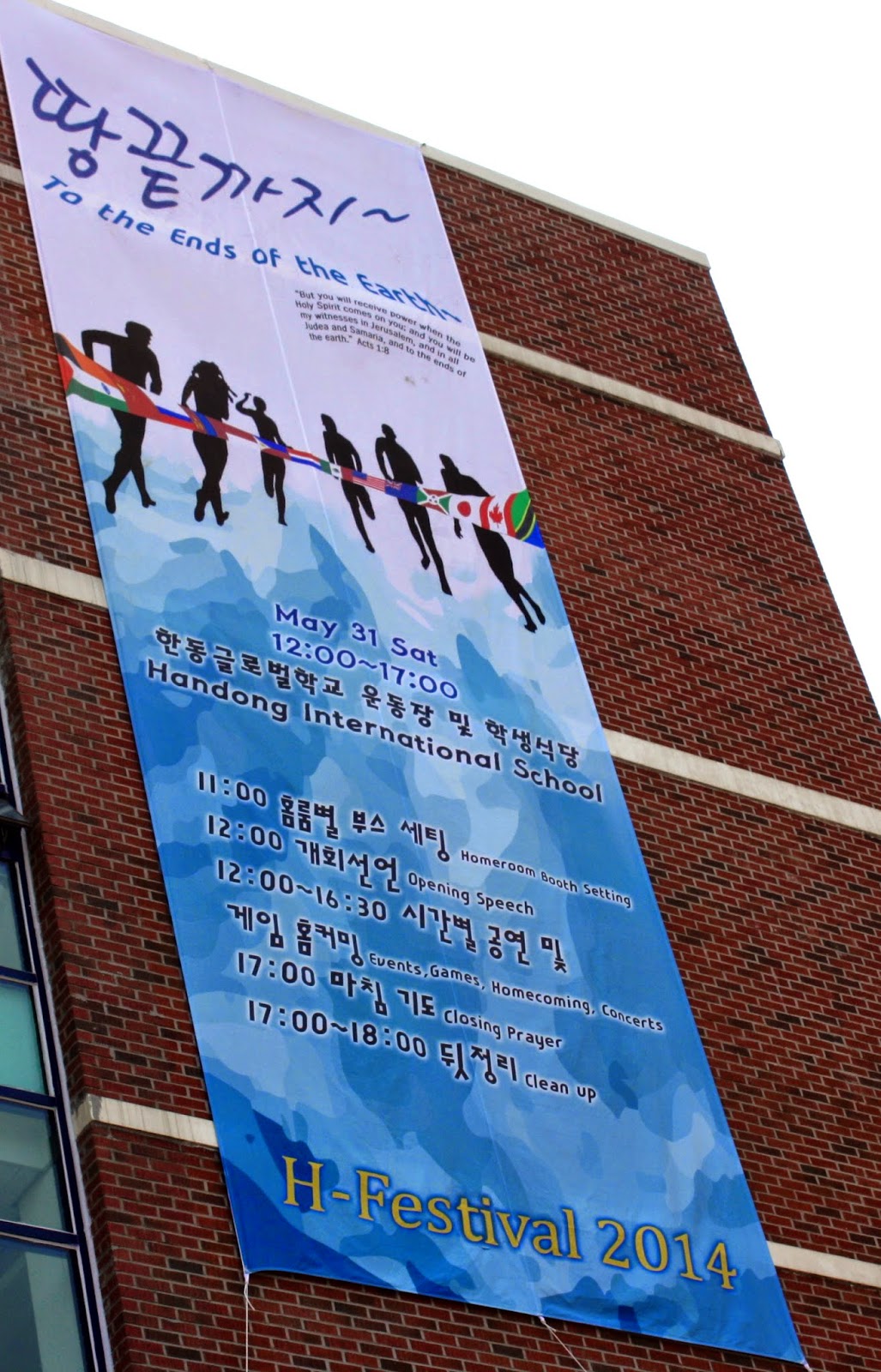
The school's festival took place on Saturday.  I was deeply delighted to learn that the kids were in charge: set-up, selling tickets, entertainment, and running the booths.  Each class had an activity booth and a food booth that reflected the country they'd studied earlier in the week for International Day.  Kids also did much of the take-down and clean-up. Teachers did some casual oversight while parents and siblings kids enjoyed the music, activities, and food. This approach is far better than parent-run carnivals.  Not sure my kids would agree, but that's ok.

Elisabeth's classroom activity booth was a human whack-a-mole.  The paying whackers loved hitting the human pop-up volunteer "moles" with a toy hammer, though the "moles" didn't have quite so much fun.

David's booth had a "catch and hold" activity:
grab and hold 3 loaches (not leaches, mind you, these were fish) within one minute for a free cotton candy.
I loved it: the Winnie the Pooh inflatable pool (WHERE did they get this in Korea?) plus eely fish on a hot day.
 It was a challenge for everyone except a Korean woman who must be a master fish-catcher:
she had no trouble at all grabbing those slippery monsters.
Nick was in the US during Spirit Week and I was tiring of single-parenting, so when I saw the HIS Festival's schedule,
I was especially intrigued by the 12:15 slot: 10 Husbands!
However, later investigation showed this was a colossal typo:
it should have read HIS Band (10th grade).  Not husband.  Alas.

P.S.
What David learned during Spirit Week:
Running around barefoot on the hot plastic playground causes giant blisters.
Ouch.

Sunday, June 8, 2014

Spirit Week: A Korean Folk Tale

The last week of May was "Spirit Week" at David and Elisabeth's school (a 12-grade, mostly-English-speaking, Christian school that's happily located below our apartment balcony), and instead of having "pajama day" or "wear your clothes backwards day" like I remember from homecoming weeks of my youth, these folks do it up right. For example, Tuesday was Korea Day: many kids wore gorgeous traditional clothing and a school-wide lecture was given about Korea. 


I caught two of Elisabeth's friends (a Korean-Canadian and a Korean-American)
and some high school boys dressed in hanbok playing soccer before school;
the lecture hall was filled with Korean heads, making it easy whenever I need to find my red-heads.
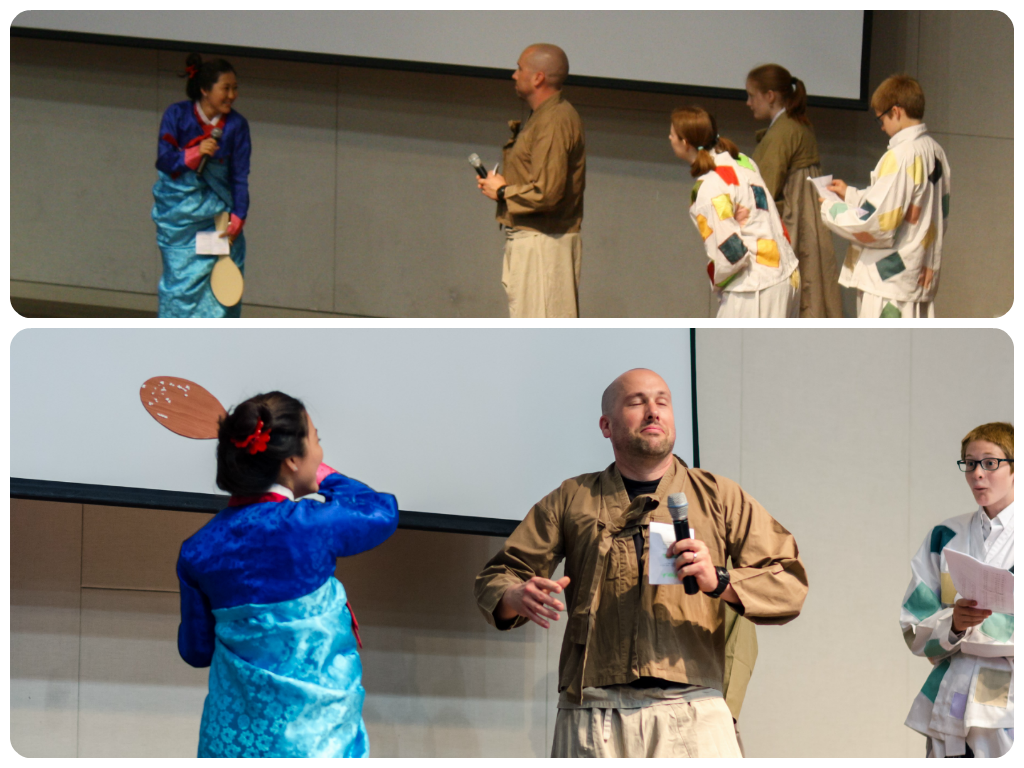
After the lecture, the school's international faculty (from the US, Canada, China, and New Guinea) enacted a traditional Korean folk story; David and Elisabeth were also required to participate by their Korean teacher (let's just say that Elisabeth was less unhappy than David about this).  I suspect the single rehearsal, held the previous afternoon, contributed to the near-slapstick acting style.  In addition, none of the actors is a native Korean speaker, so the audience (who knew the story well) had a GREAT time laughing at the delightful old tale told in truly terrible Korean.  I enjoyed the audience nearly as much as the play. 

So here's the story, as I picked up from the skit, the powerpoint slides, and my faithful assistant, Wikipedia (note: several of these pictures were taken by Aleksey Yoo (David's Russian teacher and a member of our church).

A wise old father divides his estate between his two adult sons, realizing that the evil/crafty Nolbu would otherwise leave nothing for kind Heungbu.  However, after the father's (over-the-top, butt-in-the-air) death, the greedy Nolbu steals his brother's inheritance, leaving his family destitute (thus the plain-spun hanbok rather than the bright silky clothing).

The father wisely divides his estate between his sons, dies,
and one brother still gets screwed by the other.  
Poor Heungbu's family (including Elisabeth as wife and David as child) beg for help from Nolbu's wife.  At first she gives them a small pittance, but when Heungbu returns to beg for more, she beats him and chases him away.  
I love David's look of surprise when Nolbu's wife whacks Heungbu.
Later, Heungbu notices a swallow (inexplicably dressed as a penguin in this production) with a broken leg; his family cares for the bird until it is well, when it gratefully brings them a seed that grows into a huge gourd.  When the gourd is opened (by a surprisingly sturdy cardboard saw), it is filled with riches and the family is in need of nothing.

This Canadian was a highly demonstrative swallow.  Penguin.  Whatever.

The Gourd of Abundance.
Of course, evil brother Nolbu learns of Heungbu's windfall, so he finds the swallow, breaks its leg, then sets it to heal in hopes of similar fortune. When healed, the swallow does give him a seed which produces a huge gourd.  But, when this gourd is opened, it contains not riches but a fierce goblin who beats Nolbu and his wife.  

Nolbu breaks the swallows leg, hoping to be awarded a gourd of riches
but gets a club-wielding goblin instead.
The brothers (inexplicably) reconcile and apparently live happily ever after, giggling their way off the stage.   

The cast returns to take a bow.

P.S. It ends up that the school's version of this tale was fairly tame.  For some alternatives, see these sites:

Rice Farming (more pix than info)

I grew up in a rural, mid-Michigan subdivision where a large field abutted our back yard.  Each spring I saw the corn (or beans, in alternate years) get planted by huge tractors; each summer my sister and I played near or among the growing crops (mature corn is a great place to hide, though its leaves give some nasty "paper cuts" and we always feared The Tractor coming); the crops were harvested each September by the huge combines and then the field was plowed for a long winter's rest.  All of the farming was done by machine; I don't remember ever seeing a farmer out there.

After a stint in Grand Rapids for college and then time in Chicago for graduate school, moving to Iowa was like going home: corn and beans everywhere.  Now living in Korea, where the garden-raised corn tastes like corrugated bark (I'm not sure Iowans would feed it to their cows) and the soybean fields are invisible (I have no idea where they grow enough to make the amount of soy sauce consumed here). As the campus is surrounded by rice fields, I've been curiously observing the seasons of farming.  And I quickly discovered that my dreamy vision of hand-planting rice fields in the dawning mist was a bunch of romantic crap, but, still, Korean farming is nothing like what I saw in the US. Thus, here is a selection of rice field photos and some ignorant commentary from my year here.

Early Spring:

Spring starts out bare and brown. The empty fields are plowed;
stacks of fertilizer arrive along roadsides (I assume they got put into the fields when I wasn't looking;
the fields get flooded through an elaborate, low-tech system of plastic tubing;
and flats of rice seedlings appear along field edges to grow for a couple of weeks under plastic.


Mid-Spring:

Planting time! The flats of seedlings get loaded onto the planter, which has little fingers
that pop out each rice plant and stick them in rows  across the muddy fields.
Even with an engine-powered planter, the farmers work hard to guide it in reasonably straight lines.

Late Spring:

Once the seedlings have grown for a couple of weeks, men walk about with leaf-blower-looking things that appear to spray chemicals from their backpacks.  I hope it's herbicide rather than pesticide, but I don't know.
 I loved seeing one farmer find a dry place to rest - this kind of tractor is a rare sight here.

Summer:

Summertime is for growing.  The gorgeously lush green waves are punctuated by great white herons who enjoy catching frogs and nesting in pine tree tops (looking ridiculously awkward).

Fall:

In October, fields of golden rice get harvested by small machines, then poured and transported
in giant tote bags to the grain elevators.
Sometimes hand-tied bundles of rice marked where ajummas made way for tractors entering the field.


Early Winter:

The rice stems are baled, usually into huge rolls;
some farmers have nearly-naked bales in the field for awhile, and some wrap them in white plastic
that looks a lot like giant marshmallows (or ghost poop, as one friend calls them).

Late Winter:

The shorn winter rice fields look as sad and lifeless as those in Iowa and Michigan - but without the snow!
These were taken mid-January.  :)
And, as a bonus for you faithful readers, a final picture from this week's spring rice field foray.  Too bad for the frog, I suppose.

Wednesday, June 4, 2014

Sewing Lessons from a Canoe

For some reason, I took Home Economics in 7th grade, and that's where I really learned how to sew. My mom certainly owned a sewing machine, but I don't remember using it before that point (I do remember that in order to shoot my dad's bow, I had to be able to lift 40 pounds, which was supposedly the equivalent of that sewing machine).  Far more memorable was mom's sewing box, which I loved to organize (I alphabetized my books as a child, too.  And had a tidy bedroom).  The clear plastic sewing bin was the size of a small microwave (you old timers can compare it to a bread box); the spools of thread fit neatly onto the specially-made plastic spindles affixed to the removable top tray; buttons and other notions fit neatly into the square bins; scrap fabrics were folded into the bottom of the box. Everything had a place.  And I adore that concept enough to (a) repeat it: "Everything had a place" and to (b) again request God to put it in His next edition of the Bible (I've not heard back on that). 

My first sewing project.
But I digress. In Home Ec, I learned how to thread a sewing machine and use its basic knobs and buttons and foot pedal (yes, they were electric machines, you sassy reader). We then learned to use patterns by making a stuffed animal.  (To this day I hate patterns: horrible rippy tissue paper with strange symbols and way too many lines and options).  I chose to make an octopus, for which I bought green gingham fabric (I don't know why), and followed the 3-legged pattern as closely as I could (why did it have 3 legs? A google search for today's patterns show tons of cute 8-legged versions and a few 4 legged and even 5-legged ones, but never 3. Ever.).  I vaguely remember my parents leaking snorts and giggles upon first seeing the creature.  Perhaps because the seams weren't very good and the stupid Styrofoam pellets leaked out for years hence.  Or, in retrospect, because it had three legs and looked, well, like a weird male creature.

Upon completion of that project (nightmare) I had earned Expert Seamstress Status.  At least in my own mind.  I next made a Totally Cool vest from off-white linen that was even reversible (I pause here for your admiring gasp), but ... this extra work was totally pointless as BOTH SIDES were the same fabric and color.  All the work I did to hide seams, yet utterly failed to think ahead about oh, say, DIFFERENT fabrics on the two sides. And I bought a cute buckle for the back (one side only), but it was cheap, tarnished quickly, and the stupid thing never stayed together. And the cute little pockets were so stingy as to barely admit a quarter.  But I wore the stupid thing because I am proud. Which brings us to the theme of today's essay.

I love organizing; I love weeding gardens; I love editing.  But when I get into "blank slate" kinds of situations (whether it's sewing, being a dean, or any other creative endeavor), I freeze.  I veer wildly between "The Expert is In the House" and "This is Impossible," which leads to piles of projects in various stages of not-being-done. Once I actually decide to start a creative project, I often quit in frustration, blaming the infuriatingly vague project/plan or the inadequate tools or the intrusive children or even the weather for being so...stupid. 
Nick & I on the Eleven-Point River (southern Missouri)

We must turn momentarily to the illuminating Canoe Incident of 1994 that was important in my mental, marital, and spiritual development. Nick and I went on a canoe tip with friends to southern Missouri. Now, I had canoed rivers PLENTY as a kid, thanks to my dad. Therefore, of course, I certainly knew how to canoe: Stick paddle in water, pull it back, canoe goes forward. Easy peasy.  What I did NOT know, however, was that I was never on the business end of the canoe. All those years of sitting in the front, on a slow backyard river, paddling away and imagining myself to be a Canoe Master, my dad (in the back) assessed the river and constantly made adjustments to our speed and direction.  But I didn't know any of that before our Missouri trip, where we were on a fast, winding, rapid-filled river in the middle of NOWHERE (an outfitter agreed to pick us up 4 days downriver, in Arkansas). Further, and to my imminent shame, this Canoe Master believed her husband, who had some vague experience canoeing in swamps or something (!), was a Canoe Moron.  

For the sake of time and embarrassment, let us just say that after a certain number of hours of intra-canoe tension, Nick took me to a quiet part of the river downstream (well away from our friends) and taught me how canoeing is actually done.  Just pulling a paddle does not make a canoe go straight. Instead, you have to correct for the pulling force by making more of a J or L pattern with the (stupid) paddle  And you always have to read the (stupid) river to judge its current direction and speed, etc, and make adjustments all the time.  To sum up:  Canoeing had always seemed easy not because I was so skilled, but because, well, someone smarter had quietly paid attention to all the details and had done most of the work.  I wasn't a master at all; just a prideful child with grand visions and too little motivation to pay attention to learning the basic skills.  Ouch.   

Back to sewing (you thought I'd lost the thread there, didn't you?  And hey - a sewing pun!).  Today when I was internet surfing and greedily pinning away (I shall not name That Site of Evil Goodness) I suddenly realized just how many Undone Projects I had going.  And some part of my brain quietly but quite firmly said, "ENOUGH.."

Oh. So I drafted a list of all the projects I already had underway (organizing again enables procrastination) and decided to tackle the stack of sewing, mostly involving tailoring clothes for Elisabeth.  

This was a mighty fine machine 30 years ago
(8 whole stitch options!)
As you know from above, I was An Expert Seamstress, and therefore knew how easy it is to sew: set up machine, sew, and away you go with your beautiful curtains or clothes or whatever.  But, if you're paying any attention, you already know I have a wee little problem related to assumptions. To add to the fun had by the devil on my behalf today, let's add my 30-year-old sewing machine that was roughed up in transit to Korea last year (the tension knob broke off and empathic sewing friend Tracey took me to a place to get it fixed; the guy didn't have the exact part, but he built one out of spare parts - very impressive, but temperamental (the knob, not the guy)).  Listening to that part of my brain that had said "ENOUGH.," I sat my backside down and worked on sewing.  I tried to be open to new lessons and googled my questions often, looking closely at pictures and consulting lots of "how to" sites. Along the way I may have stomped about and grumbled and perhaps even swore, and I certainly had to do a lot of things over (and over) again, but I learned a lot.  Of pretty basic stuff.  For example: 

(1) Cheap. Thread. Breaks. Often.  (And using scraps of thread gleaned from hotel sewing kits? Not worth the hassle on a machine.)
(2) Tension knobs actually do matter (oh, sure, you can ignore them if all is well, like canoeing in the front with an experienced partner in back, but if all is not well, what a snarled MESS). Corollary: testing on scrap fabric is actually worth the extra time and the "cost" of thread.  Yup. Took me a few times to learn that little lesson.
(3) Reading glasses are very useful for threading needles and picking out snarled messes.  (I'm sorry, eyes, just face it; you're not what you used to be.)
(4) Google and Pinterest are very patient teachers (though they really slowed me down from that strong inner drive to be DONE already). Careful and frequent measuring; pinning and basting; and even ironing (horrors) are keys for successful sewing.  Even if they ARE time consuming and drag the simplest project out forever, these new practices did help me feel good about my work. 

Elisabeth was incredibly patient with me, even when she got poked with pins or tried on the same thing for the tenth time.  Today I had to learn (AGAIN) that life isn't about just sticking your paddle in the water and expecting that minimum contribution to guarantee smooth sailing (just to mess with the metaphors).  Nope: good canoeing and good sewing (and probably a ten ka-billion other things) require time spent gaining lots of basic knowledge; constant attention to current conditions and needs; and the patience to deal with troubles.  

Arg.  It's so much work to be prideful and then have to re-learn everything.  Why can't I remember that?

P.S. I saw this sewing manual advice on Facebook today and had to include it here.  The first paragraph bowled me over given my above reflections; the second paragraph made me want to slap somebody.  :)


Friday, May 30, 2014

Of Pergolas and Bruschetta: A Perfect Saturday

Sketching designs
What's fun for us to do on a Saturday, you might ask?  Ah, that's too easy. It's a husband-wife building project, of course!  I love the convenience of apartment living but I dearly miss doing design/construction projects with Nick (see previous complaints here). So, today, in honor of my upcoming birthday, we did a project together. Specifically, we made a pergola (pronounced PER-gola if you're from the US, or per-GO-la if you're from Down Under) for the ex-pat community garden. We've not made one of these before, and we suspected (ok, KNEW) that doing this project in Korea would be different than our various US projects; on the plus side, we don't need building permits or inspections here (well, I don't think so).

Step 1: Design & planning.  I sketched some ideas and Nick made them prettier.  We walked out some rough dimensions in the garden then finalized a list of needed lumber and hardware.  Oops: we're in Korea, so things like "12-foot 4x4s" all needed to be re-calculated into metric. *Sigh.*

Step 2: Lumber: We scavenged enough good 2x4s from discarded benches on campus (hooray!) so we could take those off the list of things to buy. We then drove to the lumberyard and wandered around a bit (even though we maybe kind of knew Korean store owners are not fans of that American behavior -- hey, remember Little House on the Prairie? The customer would give the clerk a list of desired supplies and then waited for the items to be fetched. Pretty much like that here, too.)  Before we got accosted (I mean, waited on), I took great pleasure in now being able to read some of the Korean signs (오크 -- pronounced oh-kuh-- means oak!).  When Lumber Guy saw my design sketch he said "나무" (nah-moo), which literally means "tree."  (I had secretly hoped he'd say "wood" because Koreans drop the initial "w" so it's pronounced "ood."  Which cracks me up every single time for no very good reason, but I think of the effect on that old tongue-twister:  "How much ood ood a oodchuck chuck if a oodchuck could chuck ood?"  See?  It's funny.  And it's the same with words like "woman" and "wool."  But it's not a Korean issue with "w" per se - the word "wow" is typically pronounced "wah!," which also cracks us up.  And while we're way, way off track, we noticed a restaurant today called "Sushi Wa" which means "Raw Fish Wow." Is that a great name or what?)

Secret pic of Lumber Guy; our lumberyard (across from Hanaro Mart); Nick reverse-engineering the ood tie-downs.
Ahem.  Back to the lumberyard.  We have unexpected mathematical joy because lumber here is mostly imported from North America so it's in ENGLISH measurements!  Even so, I took perverse delight in Lumber Guy saying things that sounded like "doo bah po" (2x4) and "po bah po" (4x4).  On the other hand,  I returned the language favor by using the wrong number system to describe how many boards we needed (I used the Sino-Korean system and asked for "sah gay" instead of the Korean system to ask for "nay gay") but Lumber Guy nicely smiled and told Counter Lady of our order.  She then used her computer to look up the prices, which she carefully recorded and totaled by hand on a paper invoice. While baffled by her approach to technology, I happily observed that prices weren't much higher than at home: our 4" x 4" x 12' pressure-treated boards cost us about $17 each (taxes included); at Lowe's, a 4" x 4" x 10' pressure-treated board is about $13 each (plus tax; and a nod to Google for its pricing assistance).

Awesome Torque Screw vs. what we can get in Korea.
Step 3: Hardware store.  Now, remember: we're in Korea.  Just because a place sells lumber doesn't mean it sells anything that might cut it or attach it to anything else.  Thus, a trip to the hardware store.  (Have I mentioned how much I enjoy it when our hardware guys see us? The son, whose English is quite good, usually says "OOH!" and throws down his cigarette, coming out to the curb to greet us.  I think he's secretly hoping for another Dumb American story to tell over dinner.)  Today we showed him our lumber and tried to describe the torque screws we wanted (Lowe's actually calls them "Grip-Rite Countersinking-Head Polymer-Coated Star-Drive Deck Screws."  Try translating that.).  Alas, even after drawing a picture, we had to settle for basic steel Phillips' heads -- our hardware guys didn't have the torques.  *Sigh.*

Step 4: Lunch.  No good project is complete without (a) regular refreshments.  Twenty years ago (ok, 5 years ago) I would have also said "no good project is complete without...(b) a trip to the hospital," but I'm now far wiser about announcing my pessimistic safety forecast and Nick is less accident-prone. (Ok, to be completely fair, WE are less accident-prone.  I showed my mangled index finger to a young neighbor girl today, who wondered if our circular saw was a toy. Ah, no. Stand back, child).

(photo source: http://eatwithnat.com/)
Back to topic (a): refreshments. Today, the Italian culinary planets were aligned: we had on hand, all at the same time, french bread (thanks to the new Eat Bread bakery by the lumberyard, where I correctly requested 2 baguettes: "doo gay bah-gay-tah"), feta cheese (thank you Susan for your Costco run!), fresh-plucked basil (thank you Grace for the i-herb order!), olive oil, garlic, and a deep red tomato. Ahhh.... Just pause with me for a minute to imagine an entire year gone by without an exquisite plate of bruschetta.  We were weepy with fond memories of many plates shared with friends and family in Chicago, Iowa, and Michigan. Funny how food brings your heart home so quickly (and can make one just a wee bit snappy at certain offspring who appear from nowhere to claim a right to share this heavenly refreshment).

Nick measures; salvaged benches; Nick's students recruited to
put said benches in the van; tools at the ready.
Step 5: Back to work. Duly refreshed, we set up shop in our building's parking garage because (a) the elevator lobby has the building's only external outlet and (b) the shade felt good and (c) the breeze seemed pleased to sweep the garage of sawdust for us and I am fundamentally a very lazy person. (That's really why I grow perennials instead of annuals or veggies, you know. Transplant, water, one more water, and that's it: live or die, because I'm done coddling.  Which could also be maybe why my college roommate dashed my goal to become a counselor: no patience for more than 3 sessions).  Where was I? Oh, yes, we borrowed a few tools (thanks, Mundys!), measured and cut all the boards (ok, honestly, I just sat on the boards while Nick measured and cut), pulled nails from the salvaged boards (I did a LOT of this, so don't get all judgmental, dear reader, about any uneven labor distribution thus far--and thanks for Kurt for your help!).  And then we drove the cut lumber up to the community garden (yes, we drove.  With the van. Stop judging--I already admitted I was lazy) where David and two of his friends had obediently, if not altogether joyfully, dug the holes for the corner posts (thank you Daniel and Gunnar!).

Step 6:  Friendly Advice.  What I did not mention yet was the significant amount of neighborly commentary, advice, warnings and dire prophecies offered by folks passing through our project.  I love my neighbors (especially the Korean who saw me working and sent her husband straightaway to help), but this scenario was not quite the private Husband-Wife Project Day I had initially envisioned. We're not in Kansas anymore - why do I keep forgetting that?

Step 7: Where were we?  Oh yes, back to the garden. We put in the posts, made supports and did lots of measuring and leveling, then Elisabeth and I filled the 3' deep holes with rocks and beach sand, using plenty of water to cement it all in there.  Tracey and Alex wandered by and got seduced into helping with measuring, leveling, and general encouragement via stories of various Australian characters (besides themselves).
Elisabeth packing the ground around the corner posts; a documented family project;
Tracey & Alex Banks lending their assorted assistance
Ah.... The project is not quite done, but it was a wonderful, perfect, Korean day.

Wednesday, May 28, 2014

Silkworm Doom: I had no idea.

On my birthday, Nick flew to the US for his brother's wedding. Ah, well; on my birthday last year I was flying to Korea. I did get to see David and Elisabeth in a skit about a traditional Korean folk story (see a separate blog); have lunch and visit a new pottery shop with Korean-American friend Grace, where we admired many traditional forms of plates, bowls, platters, etc.; and had coffee and visited Jukdo Market with Australian friend Tracey. This last visit prompts today's blog.

I have been to Jukdo's enormous open-air market several times before (see here and here, for examples), so I was not surprised by the tanks of creeping crabs or writhing eels; the elderly lady vigorously chopping off fish heads on her mid-aisle push-cart, flinging droplets from her giant knife onto nearby merchandise (thanks to CSI for the concept of "castoff"); the neatly-stacked piles of produce; the men on scooters flying down the crowded aisles. Nope - generally not surprised. But then we found something new, which later research showed to be rather horrifying.

Now, Tracey had decided this would be an EXCELLENT opportunity to make me practice my Korean. "Alma yay yo?" I was forced to ask to learn the price of items. Asking wasn't as bad as having them answer, because it takes me so long to figure out what they're saying. Tracey stood by, poking me along with her grin and comments to the shopowner (in Korean) like "She is studying Korean." They laughed. She's a horrible woman, really. 
 
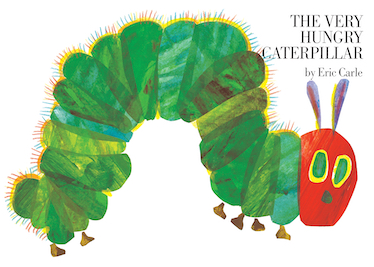
After getting some potatoes, onions, and t-something-root (the edible root of the bellflower - campanella), we noticed a new shop/stand with caterpillars. Hundreds of pale white creatures about 3 inches long crawled over one another in a wooden box as they happily munched on leaves. Tracey suspected these were silkworms. Ooh! Silkworms! I felt a a wave of nostalgia for pleasant afternoons spent reading "The Very Hungry Caterpillar" to my kids; I vaguely recalled the care needed for these helpless creatures who thoughtfully provide us with astonishingly strong and beautiful silk. Ah, silkworm caterpillars! I have truly arrived in the Far East!


Upon inspection, however, we saw no sign of silk anywhere on, in, or near the crawling horde, and no colorful clothes or soft fabrics to indicate a silk business. Hmm. We began doubting our silkworm hypothesis and thus tried questioning the vendor, a middle-aged man who knew less English than your average bear. He waved toward some small bags of dark brown liquid, a cart with bowls of sticks and spices (?), and then to the small kitchen-like room behind him with shiny gadgets and clay kimchi pots (for traditional fermentation). Together, these suggested that the friendly caterpillars were intended for, ah, processing. Perhaps even for human consumption. Eew. My imagination, which really, really should have been stopped here, quickly connected the squirmy critters with the brown bagged liquid, and then jumped to the horrible vision of tomato hornworms being squashed underfoot like ketchup packets (I think I read that in a book - I hope, hope, hope I didn't actually see/hear someone do this) and then my imagination moved to the vile possibility of people scarfing down the resulting goo.


Great. Now I was looking at the wormy pile with a whole lot less romantic admiration and a whole lot more revulsion and a strong desire for Not Knowing More. Tracey, who apparently had not had any such vivid visions, thought we should take a picture of this unique shop's display. I reluctantly asked the man for permission, pointing first to my camera then to him and the caterpillars. He countered with a request for "mahn won" -- about $10. I laughed and said no, but he asked for a counter offer. Ah, bargaining. The only Korean money-word I could think of was "oh-bek won" (a 500-won coin I usually use for the dryer, worth about $0.50). He smiled and shook his head, but said "service!" and with one finger pointed to the box of squirming goo packets. Ah - we could take 1 picture for free! Tracey grabbed my camera, had me pose by the caterpillars, and snapped not 1 but 2 pictures. The man's mood thus shifted so we bowed and slipped away, still pondering the purpose of these voracious little creatures.

As you might suspect, I later asked my home-bound research assistant (perhaps you've met "Google"?) to explain what we'd seen. And I asked a Korean friend to translate the sign next to the shop (our 3rd picture, which I snuck in as we dashed away). She said she would do more research. Hmm. A few days later I asked my Korean tutor about the sign. After squirming and consulting her smart phone's dictionary, her face turned red as she said "Ah... it's about men... it's for sexual excitement. And there are dried frog legs in that basket behind the sign. I think they're good for your health." Of course they are.
And so, here is the education part of today's blog (sort of like CSI shows always have a "musical interlude" section in the lab). I shall keep it short but have thoughtfully included an Appendix for those dear readers who desire further distraction, extra credit, or homeschooling activities for restless children. We indeed had seen silkworms (the points Tracey gained for correct identification hardly made up for forcing me to speak Korean). Of the actual silk-making process, more later, as these particular critters were destined for another purpose altogether: to be transformed into "herbal remedies" (synonyms: traditional/Chinese/Korean; medicine/supplements/treatments). These remedies appear have three kinds of desirable effects on humans:
(a) reduce phlegm (perhaps necessary in a culture where men smoke so much?),

(b) reduce gas (my favorite description was "dispels wind and settles down fright"), and

(c) enhance male virility. Oh boy. Silkworms are Korean Viagra. More eew.

Momentarily forgetting my earlier vision of squirting ketchup packets, I wanted to know HOW these hungry caterpillars became, well, fart medicine, among other things. From what I can tell, there are two methods. (Warning: both of these make livestock slaughter in Iowa seem almost reverential). Some sites suggest a "liquid extract" process but are silent about exactly how a living creature's liquids get extracted. Other sites describe a fungus/fermenting process. First, your silkworm guy injects/infects the creatures with a disease called white muscardine. As it turns out, this is an "entomopathogenic fungus" that slowly kills its insect or spider host while developing its "fruit" - a mushroomy thing that grows out of the body (perhaps you've heard of the mushroom/supplement Cordyceps? Yup--same thing. See more in the Appendix, below). This disease is a nightmare. I found pictures online. Here they are. I'm sorry.
Evil fungus growing out of a bee, a now-headless-fly, and a tarantula.  Truly horrible.

Silkworm-Dongchunghacho(Page1)
Cross-section of a silkworm with its deadly
parasitic fungus (source).
Ok, deep breath. These poor hungry caterpillars were doomed to become liquid or fungal remedies for human farts, phlegm, and male insecurity. Eric Carle didn't give me a clue about this possible ending to his beloved children's book.

So, what about silk production? Could I have valiently set these critters free to become happy butterflies? As any child knows, the once-hungry caterpillar spins itself a cocoon from whence it begins that marvelous miracle of turning into a beautiful...STOP. Unhappily, Google destoyed my innocence and over-informed me yet again. These caterpillars, on the very cusp of butterfly adulthood in their homemade, silky-soft bungalows, are unceremoniously dumped into boiling water (ok, maybe there's a ceremony. What do I know?). I learned that people don't just "unwind" the cocoons or wait until the butterflies emerge to harvest the silk (FYI: my ignorance isn't completely my fault. Many educational sites skip right over the ugly bits of silk production: see here and here and here). Oh, no, the boiling cocoon treatment definitely kills the proto-butterfly but does provide a side benefit of snacktime fun for Asians (see below) in addition to loosening the silk for mechanical unwinding and spinning. If you waited until a butterfly left the cocoon, it would break the silk (which doesn't suit people's needs), so it's killed before it emerges. Thus, silk collection is more like mink fur harvesting than chicken egg collection or alpaca wool harvesting. It's butterfly murder it what it is.
Can you imagine these signs at an anti-silk rally?  Yeah, me neither.

Ok, ok, dear reader. It's surely not the same as plunging a cute furry creature into boiling water, but it's still a creature for which I admittedly have (had!) all-too-romantic notions. And I can't imagine any resulting social outrage against silk as there has been against the wearing of fur, but still. I had no idea. I'm so sorry. I'm a gardener and bird-watcher and butterfly-lover. This was distressing news. 
 
Butterfly murder. Quite a memorable birthday.


Appendix (a.k.a. info for readers actually interested in learning more about silkworms):

(a) Now, boiled silkworms as snackfood? Indeed. Boiled silkworms are common among Korean street vendors and are attractively packaged at the grocery store and the ubiquitous 7-11 stores. We got a sidedish of them at a traditional Korean dinner a couple of weeks ago. I could not - NOT - bear to eat it, so I stabbed one with my chopstick, waved it around out of eyesight while talking about some banal subject, and popped it into my mouth before I could think about it. The closest I can come to describing it is a boiled hazelnut. Kind of chewy and nutty. And then my imagination turned back on and I knew that I could not trick myself into eating any more. Ever. (If you want to know more about the silkworm as healthy snack from a British perspective, see this article.)

(b) Maybe you've seen or bought Cordyceps as an herbal supplement? White muscardine is the disease inflicted on silkworms that creates the cordyceps fungus; clearly, the clever marketers only depict part of the mushroom story on the packages.

: 

Cordyceps History and Cultivation
Where the cordyceps fungus really comes from.  Eew.


We're missing about half of the "activated mushrooms" in these pictures.

(c) References:

Click here for more about White Muscardine. 

For more on the process of infecting silkworms,check out this academic article from the National Institute of Health. 

 If you'd like more about silkworm-based-medicine, here are 3 useful-ish sites:

(a) Silkworm Extract Benefits

(b) ActiveHerb™ Jiang Can Product Details

(c) Jiang Can (Silkworm): Chinese Herbal Medicine

Monday, May 19, 2014

Finding a Tragedy (Cheng Lu 15)

Nick and I went looking for sea glass today, but instead we found a salvaged sunken ship.  Seriously. We later learned that this Chinese cargo vessel sank at Pohang's northern port--just minutes from us!-- in fall 2013--while we were here!  Very exciting--like a close call with a world event!  But more research revealed where I was and what I was doing during the ship's sinking, and that hit way too close to home.

One of the tiny "beaches" by Jukcheon1-ri;
you can see Pohang's city lights in the background.
Here's the story. Yesterday was a lazy Sunday afternoon, kids were playing with friends, and Nick and I decided to take a beach stroll. I was in the mood for sea glass, so we drove to the closest seaside village (Jukcheon1-ri), whose many small "beaches" (skinny slits of sand and rock between road/seawall and sea - mentioned before) normally boast buckets of glass. It appears that the villagers and their fishing friends consume vast quantities of soju (think Korean vodka) then dash the bottles overboard or against the fishing piers, where ocean waves tumble smooth the glass and carry it to shore. (Mind you, I am not judging these bottle-smashing soju drinkers: breaking glass makes a decidedly lovely sound, reminding me of glorious hours spent at the Chicago and Sioux Center city recycling bins, relieving much stress.  However, I do find it odd that they'd so willingly pollute their own fishing waters, but that's for another day).

Today, though, the beaches only offered a tremendous amount of seaweed, which (a) covers up any sea glass, (b) smells pretty bad, (c) is very slippery, and (d) is itself covered with ajummas seeking the best bits to fling up on the road to dry in the sun for later snacking.  The seaweed, that it, not the ajummas.

Our route from Handong, through Jukcheon-ri, to Youngilman port where we found the ship.
The rectangular port proper is about 1 x 2 kilometers in size.  
So, we drove down the precarious sea-side road, fruitlessly seeking a seaweed-free zone.  Alas, poor Yorick, the seaglass hunt was not to be. Heading home the long way, we drove past the new-ish Youngilman Port (opened in 2009).  The area has many enormous steel and ship-related warehouses, and it's not unusual to see huge ship-bits scattered alongside the road, waiting for welding or painting or other shippery things, I suppose. But today, as we neared the port, we noticed a very unusual shape, like a ship, but in the shipping terminal area rather than back in the industrial park.

Our first sighting of this strange ship-bit.
Being curious, and having plenty of time on our hands, we briefly weighed the wisdom of sneaking a closer look given the risk of arrest by angry Korean-speaking port authorities.  But when two cars zoomed through the slightly-open barrier and past the empty guard shack, we did too.  The ship's hulk was terribly rusty; a fishing net was snagged on its deck. The hull looked viciously smashed, the metal curled like an alien had exploded out of the bilge tanks. We concluded it was certainly not a newly manufactured ship, but probably an old boat the local steel industry folks brought up to salvage for its metal.

We continued driving in the prohibited area, feeling slightly naughty, and at the very end we found the other half of the ship, rusting badly and steadily leaking oil onto the cement.  We walked around it, noticing dozens of "Oil Sorbent" boxes, piles of towels, platoons of acetylene tanks, and a crumpled heap of oily plastic floats (for a brief oil containment education, check here).  Aha - maybe this old boat was salvaged because of an oil spillage problem?  We tip-toed through the kitty-litter-like absorbent stuff, and eventually came across a badly torn, muddy mattress, apparently pulled from the ship; a large kitchen ladle and a beat-up fire extinguisher were further signs of humanity.  We re-adjusted our conclusion once again, realizing this wasn't merely a rusty, leaking hulk destined for recycling, but possibly the remains of a tragedy at sea.

Remnants from Cheng Lu 15's stern, taken at Youngilman Port, Pohang.
Back at home, my trusty research assistant (Google) was surprisingly peckish about giving us more information on this ship. But what I finally pieced together astonished us. The Cheng Lu 15 is (was) a cargo ship from China, sailing under the Panama flag (for what bureaucratic/political purpose I don't understand).  Just 7 months ago, it had unloaded its cargo at the Pohang port and, because of the afternoon's storm, the captain decided to spend the night anchored near the port's breakwater before heading to Japan.  The ship had 130 tons of oil and diesel still on board, plus 19 crewmen.

The raging storm repeatedly slammed the Cheng Lu against the concrete wall, tearing a hole in its side. As the ship quickly sank beneath the towering waves, the captain ordered all hands to abandon ship. They quickly donned life jackets, then some rapidly climbed the mast and others jumped for the seawall or boarded a life raft. Hundreds of rescuers arrived but were helpless in the wild wind and waves. Hours later, the 8 men clinging to the tip of the sunken boat's mast were finally saved; the other 11 crewmen died at sea.  (For the best articles, photos, and videos, see these three sites: here, here, and here).
The Cheng Lu 15 before and during rescue operations (photos from sites linked above).


In reflecting on how this ship had sunk just a few minutes' drive away, and without me ever hearing about it, I wondered what I was doing at the time. I looked through my pictures for October 15, 2013, and found... oh.  Oh no. This was the very storm, the very afternoon when Nick's parents, Sam, and I went to Pine Resort Beach (often called Chilpo Beach) to see the stormy waves, and we marveled at the hugely strong winds that lifted us at each step and at the sand that exfoliated any exposed skin.


Pine Resort Beach (Chilpo) two hours before the Cheng Lu 15 crashed at Youngilman Port;
you can just see the port's cranes over Ray's shoulder (upper right).
Within 2 hours of our beach jaunt, at the port just a mile or so away, the Cheng Lu 15 sank and many men died. And we didn't even know about it.  (For readers familiar with Sioux Center, IA, it's like you're happily flying kites in Children's Park and then a big plane crashes in Sandy Hollow and you had no clue about this until you stumbled across the plane when you went camping a few months later.)

I couldn't get past the sharp contrast between the storm I had associated with joyous playfulness and the mortal tragedy for this wrecked ship and the lives of many families. Maybe my problem was the realization that my blithe attitude toward the ocean's power (and lots of other things outside my control) needs adjustment. Or maybe it's twisted guilt for having giddy fun on the beach when folks nearby would die in that same storm.  Or that bad things can happen, nearby, and I have no clue about them in my little ex-pat bubble.