Sunday, November 10, 2013

Signs of the Times (and the Koreans)

This snowman cracks me up. 
I've been collecting more Korean signs and logos that need sharing.  Here are assorted pictures with comments that may or may not explain what these are about.


Part of a sign about upcoming sales at Lotte,  a premiere department store.

Ah, the boldness of medical marketing.  From Costco in Daegu
(about 75 miles from Pohang).

I hadn't previously  realized the importance of beef sexing for
your average meat customer.

From a Costco bread display.  I would like to believe this is a bad
translation of "wheat germ."

In case you wondered just how much weight you would lose while admiring
the fall colors and waterfalls at Bogyeongsa.

I can't decide how many of these to buy for Christmas presents,
just because I can.  (Jukdo Market, Pohang)

Some people must appreciate the soothing, pre-printed meditations  on their plastic dressers (E-mart in Hyeunghae).

For those of us wondering what to call this big old pane of glass
being installed in the Seoul subway.

Happy sentiments from your friendly dry cleaners.


Um, no.  Really.  Keep your flatus to yourself, please. 

This says Korean Moms Career Day.  But the pictures suggests
a McDonald's match-making service. 

POSCO is one of the very biggest steel makers in the entire world.  But this sign raises some question about its mission.  Or its marketing team.
On a prominent sign at Bukbu welcoming all the foreign nationals
in Pohang.  Sorry, Rwanda. 

On the front door of The Sunshine Hotel which appears to be
a prominent "business" or "love" hotel.   Perhaps the American song lyric plus
a weird old English poem are intended to draw an international clientele.

Not really sure what was intended here, but I appreciate the warning.

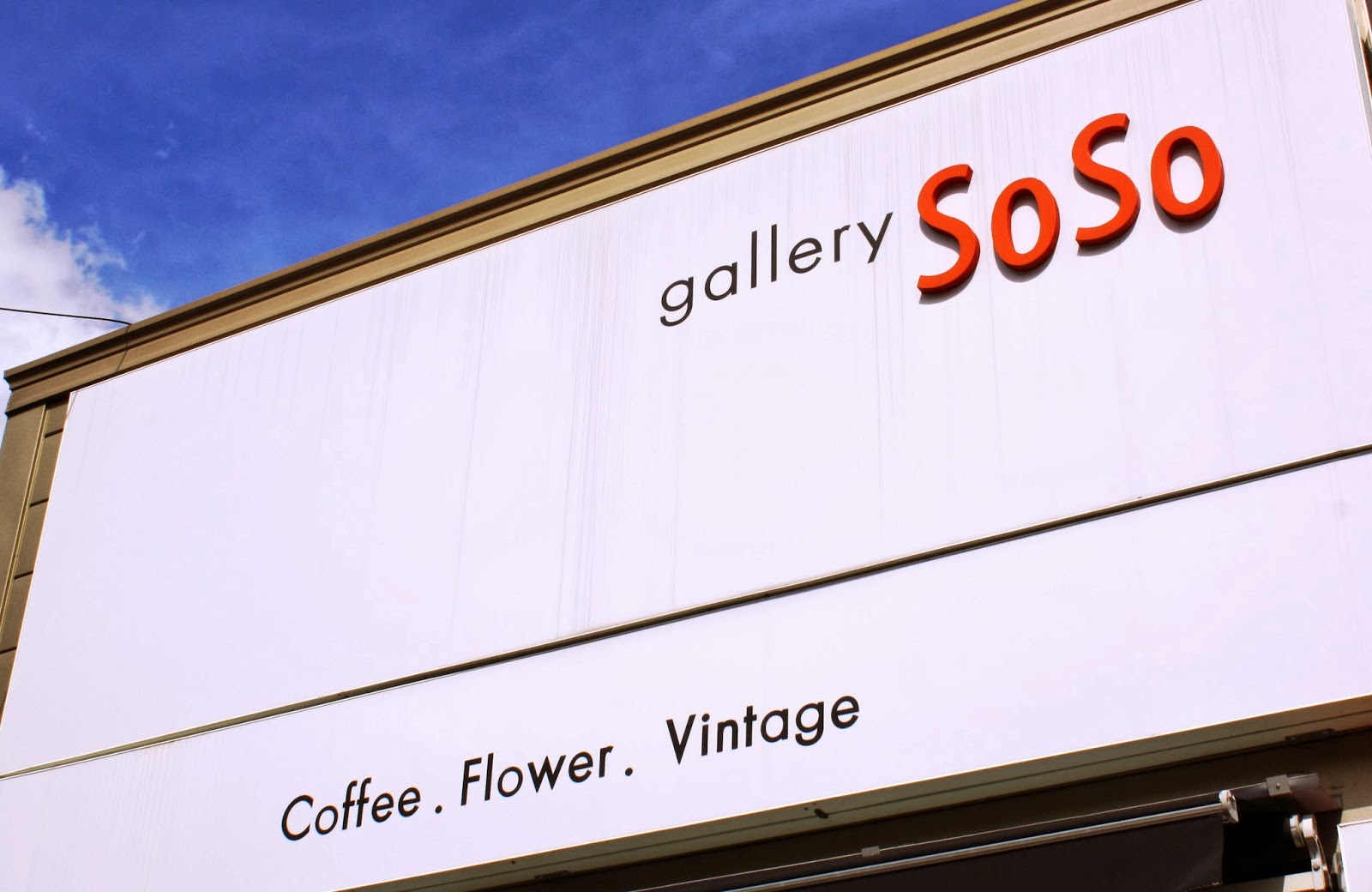
We're not sure what we sell, but it's pretty good. 

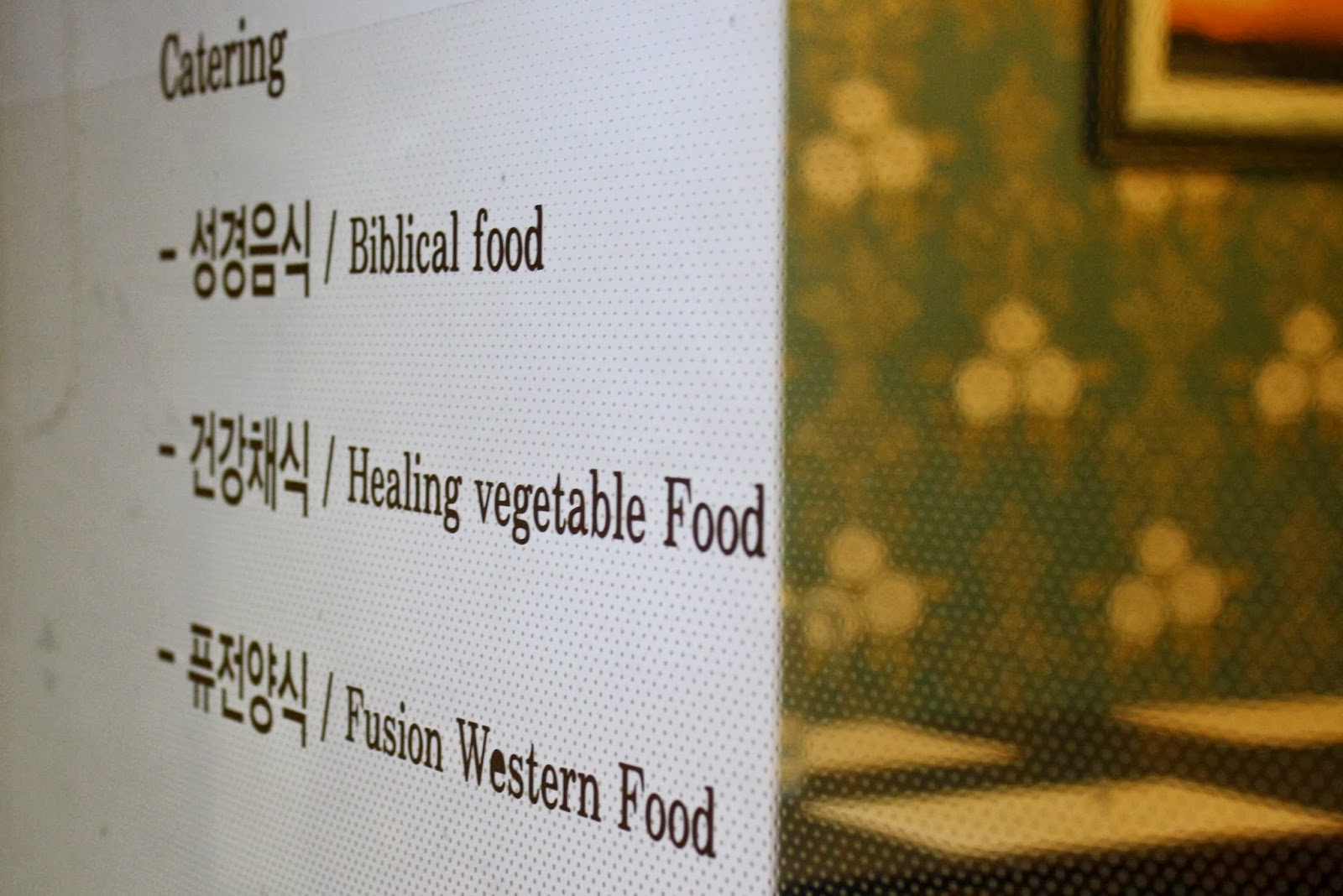
Despite the confusion about what kind of food they serve, it was fantastic.
(I'd call it French/Korean fusion, at Mom & Sons restaurant.)

One of my favorite Korean knock-offs of North Face brand.  

Yet more Korean knock-offs.

And who wouldn't like their shoe philosophy
printed right on their slipper?

Not sure what message they were going for here.
Nothing like freaking out the kids with a creepy message on their trash can.

Monday, October 7, 2013

At the Beach (introducing some blue creatures)

I get to the beach at least once a day. The closest one is a 5.5 minute drive away (slightly longer if you acknowledge the red lights and stop signs, but we're in rural Korea where there are no traffic cops, speed cameras are scarce and well-announced, and to stop at red lights would cause more accidents than not stopping), but many beaches are within 20 minutes of campus.  Some people walk or bike to the beach, but I have never been known for patience.  Or exercise.

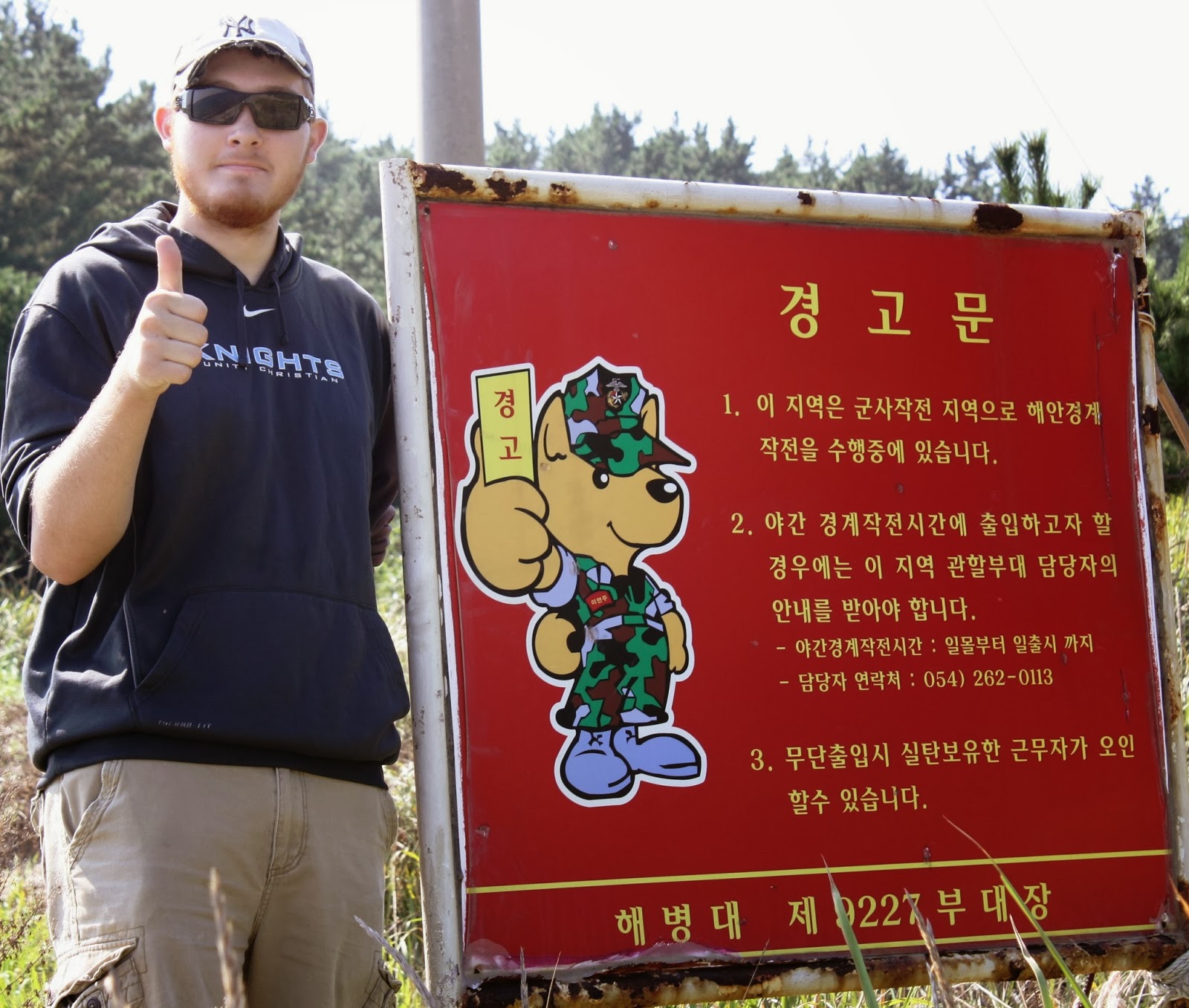
Sam posing with a typical military sign. We have
no idea what it says, but the mascot looks so
friendly, we assume no one will shoot us.
I make it sound like there are dozens of discrete beaches, but it's all one coastline, of course. And it's all FREE public access! Well, ok, the military likes to throw some razor wire down in the bushes sometimes with signs that have a rather non-threatening mascot and lots of Korean we can't read anyway, so we treat the coast as IF it's all public.


Sam examining a styrofoam fishing bobber at the rocky
cliffs (military area north of Chilpo-ri).
Not all of the coast is beach, though - some is rocky, some is harbor, and some is sea-wall.  But every part is pretty interesting.


Sam and Nick enjoying their roman candles against
the backdrop of Youngilman Port.

If our beaches have official names, I don't know them and couldn't easily read or remember them anyway, so we label them by what we've found or done there. So, we have sand dollar beach (the only place we find these crazy creatures), 4-point beach (for the giant concrete "jacks" that serve as a seawall), nautilus beach (where we found that rare octopus a few months ago), fireworks beach (where we sent some roman candles over the twilit water, bringing out an admiring raw fish restaurant owner), duck orgy beach (we don't know what got into those mallards), tiny shells beach, etc. Some beaches are particularly good for body-surfing (nautilus beach has big waves AND no pointy rocks, which is a plus for those with skin abrasion hysteria); others are good for finding particular items (sea glass; live crabs; ajeemas); and, finally, others are particularly nice for long walks, skipping stones, etc.  So why these daily beach trips?  I really love getting off-campus, getting some exercise that doesn't FEEL like exercise, and seeing so much sea and sky seems to calm my oft-frantic soul (who would have guessed I'd miss the giant Iowa sky?).  I also find these trips fulfill my inner packrat and I enjoy finding new creatures to learn more about.  Sam believes I look like a sandpiper, flitting and bending to check out some rock or shell before skittering on to examine the next bit of flotsam.

Which brings us back around (at LAST! say you linear, non-ADD readers) to some new creatures.

We've seen a beautiful (though rather lumpy) starfish living in happy groups next to the fishing pier (or sadly dying/drying/rotting atop said pier), but this weekend we were wading at "fireworks beach" and found these funny creatures right at our feet! I showed the kids how to pick them up (like I'm an expert - totally faking it, parent-style), and upon flipping them over we discovered their "everted" stomachs, which they hastily sucked back inside themselves. Sam and David were horrified by this behavior and refused to touch them. Nick was distracted by a seawall nest of giant earwigs (but took some great pictures and at least feigned fascination).

Elisabeth shows off a dark blue speciman, with its attached rock;
note the bat-like, leathery "wings" between its fleshy arms.

Ooh, look! A stomach a-laying on that bright orange side!
Just imagine throwing up part of your stomach every time you
want to start eating ...

...then sucking it back in (with its partially digested goodies)
for further digestion in your other stomach.   Nice.
A purply-blue one and a greenish one.  I love that Elisabeth
had no problem holding and admiring these.
The boys really need to man up. 

This purply-blue one had 7 legs instead of 5.
Happily, the other starfish still loved him (her?)
and let him join in all their starfish games. 
Back at home, some really outstanding research (thank you, google) showed that these leathery creatures are called "blue bat starfish" and are common in the East Sea (no one here calls it the Sea of Japan - too much bad blood between Korea and THAT empire).

The next day, at nautilus beach, we discovered some small, bright blue discs with hairy fringes - sort of like a sea anenome. A rigorous stint of (google) revealed these to be jellyfish!  To be precise, these are "blue button jellyfish" or, almost as much fun to say out loud, "porpita porpita."  However, these are not true jellies (I was feeling a wee bit jerked around by Google at this point): the center disk is one animal, and the tentacles are a colony of other little creatures that all work together. We didn't find any live ones, but I gathered some beached ones (ranging from pea-sized to a US nickel) to look at more closely; mine are missing most of their colony-tentacles, so if you want better pictures, go ask google.  :)
Blue Button Jellyfish: the shiny blue "floats" are intact
but these dead/beached ones are mostly missing
their hydra colonies.
Now, if you know my habits, you might not be surprised that my love of the beach includes a fascination with the garbage that comes ashore (besides all the fishing nets and vast variety of bobbers, which we ignore as Standard Fisher Fare). Beaches with no garbage (in the city) don't hold my interest for long.

On our Always Found list are gloves, shoes, and lighters. It's a running joke that we can't leave the beach until we've found all 3 types of these items (which normally takes just a few minutes). Our Almost Always list includes toothbrushes and whole light bulbs (usually incandescent, but also fluorescent - never the CFL ones), in addition to water bottles, beer bottles, and red chili peppers.

Some unique finds are pictured here:

Elisabeth shows off our found rocking horse
at "sand dollar beach" (Jukcheon-ri,
south of Youngilman Port)

An intact bag of breast milk, presumably from
a Westerner (all writing in English).
Again at "sand dollar beach."


Sam and David show off the biggest bulbs - these are
apparently from a squid boat, which uses lights at night
to attract the squid. 
So, the daily beach is an admittedly quiet adventure, with a pretty indirect route for interacting with Korean culture.  But the October sea remains warm enough for wading and God provides new delights for the shy stone skippers and sand pipers among us.

Thursday, September 26, 2013

Engaging Culture: Assorted Photos

For today's blog, I decided to use pictures that reflect our everyday experiences in the city, countryside, and at the beach. (To see larger versions of the pictures, just click on them - you can see a slideshow that way without all the text).  :)

 
Street vendors. 

It's common to see street vendors squatting alongside small piles of in-season fruits and veggies. Nearly all of these are elderly women. This vendor is seated (very rare - squatting is far more typical), and is wearing plastic bags on her head and body to protect her against the rain. The contrast with the LG ad is striking.


Computer/video game center.


We see a lot of signs for "PC Bangs" (literally, "computer rooms") where kids pay about $1/hour to play multi-player computer games.  The name and logo of this particular one, however, with a beaver holding a wooden sign, would NOT work in an American context.


Pre-school book.


We never run out of awkward English examples. This was an early-reader book we found in a pile of English-as-a-second language resources.  I love the sub-title about relaxing with joy and choosing the way of happiness.  Clear influence of buddhism here.


Weeding the rice field ditch by taxi.

When driving home from the beach (see our building just left of the telephone pole?), we often cut through the rice fields.  This day we noticed a taxi (rare outside the city). The driver and (passenger? friend?) were out pulling weeds from the rice/road area.  You can really tell who tends their fields (nearly no grasses or weeds amid the rice) and those who don't, as the rice is golden and the weeds stand about against it.


Surfboard upcycled into a bench.
We live just 10 minutes away from a renowned surf beach, and several (tiny) shops have surfboards, sailboards, scuba gear, and even para-sails.  I love this surfboard-bench, made from old office chairs and a surfboard. I manage to walk a beach almost every day to see what the tide has brought in. We find shoes, gloves, fishing bobbers/nets, and disposable lighters on every walk; whole lightbulbs are fairly typical  too, though I can't imagine how they survive the surf.


Ajeema collecting seaweed.
At one beach in particular, we often see a few ajeemas collecting a particular type of seaweed (sometimes called "dead man's fingers"). The ladies are usually in full sun gear, but this woman wasn't afraid to show her legs.  She used a stick to grab the seaweed out of each wave; others use their hands or just go through what's laying on the beach.


Seaweed Samaritan.
Sometimes I also collect the seaweed and bring it to the ajeemas, careful to bring some to each one who is out collecting.  I usually get a smile and nod from them - and I'm sure they enjoy having a story to share over dinner that night.


Garden spider.  


We had garden spiders in Iowa and enjoyed touching their webs to see them dance (or, as wikipedia prefers to describe it: "oscillate the web vigorously"). They're common here, though a bit bigger than what I'm used to: 3+ inches.  Praying mantises are also common and are larger than in Iowa - we saw an enormous one last week, about 6" long.  I did not love that.


Asian swamp eel.
This was a new creature for me to see on the beach: like a worm or snake, but vertically flattened.  It was slow and appeared to be nearly dead, so I picked it up by the tail for a closer look. I was so surprised when it thrashed and writhed and flapped about that I screamed and flung it into the water, where it rapidly swam away then crawled back out onto the beach.  Google told me this was a baby swamp eel - only 4" long, and they can grow to 40+ inches.  Eew.


Pale frog (marsh frog? unsure)

A small pond on campus has lots of small, bright green frogs, and I have seen this large, pale frog a few times. I used to love watching birds and butterflies, but as I get older and lazier I prefer watching slower creatures.  They're easier to photograph, too.  :)

Monday, September 23, 2013

Korean Thanksgiving: Harvest of Surprises

Korean Thanksgiving (Chuseok) came early this year: it floats around the harvest moon's schedule, much like Easter bobs about in spring. Chuseok combines harvest festivities with ancestor reverence, and I had done my research on what to expect.  As a social psychologist (ok, Licensed People Watcher), I looked forward to witnessing some burial mound bowing, traditional dress, and food offerings.


I had monitored local burial mounds for many days, noticing that they were getting cleaned up as part of the annual ritual.  Happily, the mound below our kitchen window was also cleaned up (hmmm...having an unnamed dead person buried outside my kitchen seems normal now).  We'd been seeing a lot of weed-whackers in action, though they often lack the plastic housing/guard.  In the grocery store, we even saw one with a frightening saw-blade at the bottom - later google research revealed that it's a "paddy cutter," apparently used for harvesting rice. Ok, but still: who thought of inventing (let along USING) a power saw to swing around one's feet while slipping through the muck?  I think the local surgeon's guild is getting kickbacks on this piece of machinery.

Anyway.  Back to Chuseok. During Elisabeth's violin lesson last week, Nick and I went to the Lotte Department Store - the priciest place in town for fashionable clothing and an elite selection of groceries. I wanted to see the traditional Chuseok foods and giftsets, which one is supposed to give to family, friends, and business associates.
Mushrooms: $250.

Cantaloupe, complete with plastic wrap, paper
"underwear" and a bow for about $11.  Each.
A scary American woman imagining
a bite of this giant apple (about $5 each),
which is also over-packaged.
Whole walnuts, tucked into their own
little slots.


On Chuseok morning, Nick and I hiked a path we'd not traveled before so I could find some Traditional Ancestral Rites.We ended up going through a horse corral (oops - you never know where these paths will lead) then under the highway to a tiny village.


As we walked up the gravel hill among rice paddies, a few really nice cars went past us, driven by men wearing business suits. Strange. Then a be-suited Korean man on a motorbike passed us, presumably to visit his family on this festive occasion. I used Nick as camera bait, but got caught by the man, who was not fooled by my tactics.


We continued into the village, where I admired a recently-planted garden of something radishy-looking. The red pepper season is over now: the peppers were picked and laid out to dry, then the plants yanked and the ground tilled and re-planted with this same radishy-looking plant in most gardens. My camera suddenly stopped working as I tried to get a picture of the neat rows along the tiny traditional house with four shiny cars in front, and as I tinkered with it, squatting awkwardly, an elderly ajeema came barreling out of the house toward us.

Now, Sam has proposed a new Guinness World Record category: number of ajeemas smiling at the same time (Sam believes the current record is ONE.)  To our surprise, this lady was beaming.  Dressed nicely (though not in traditional clothing) and with tiny gold hoop earrings, she spoke to us rapidly in Korean.  The only word I understood was Handong, so she correctly connected us to the university.  ("But how did she know?" I stupidly wondered later to Nick. "Um," he responded, as nicely as possible, "we're clearly not from around here." Oh. Yes. I forget myself sometimes).  Wanting to engage her somehow, I pointed to her garden, asking "bro-co -lee?" (the only non-squash veggie vocab word I know); she shook her head then spieled away about the plants and gardens and who knows what else. After we continued walking, we saw a young man in another garden, and he did not look happy.  Bored, sullen, teenager; probably stuck at his grandma's house out in the sticks with family all day, no wi-fi, and it's only 8am.  Poor kid.

Once we got back to campus I kept checking the mound outside for some action. Nothing. By 11am, I decided to go Looking for Culture and went hiking with Sam and Elisabeth.  An extended Korean family went into the woods ahead of us and we saw them less than an hour later, returning with empty cartons from Baskin-Robbins.  Hmm.  Others drove by us in shiny sedans (paths are often used by cars to access fields, burial mounds, and I don't know what else), some dressed up in suits but more commonly in "business casual"; one group of men (young cousins?) wore tank tops and shorts.

Well.  Chuseok was not what I expected.  Perhaps it's like foreigners in the US for our Thanksgiving: they might expect over-dressed Puritans to invite scantily-clad Native Americans for a turkey hunt, amusing stories of the Mayflower, and corn-planting lessons from Squanto.  I'm not sure.  Perhaps living in a rural area (anything not in Seoul is considered rural, I think) makes for more private rituals.  I don't know.

That evening we went to the beach and saw an elderly ajeema with a tiny dog.  Nick asked "Picture?" and she nodded, posing her little dog, apparently assuming I wanted a picture of that instead of her.  I'm considering doing a series of pictures of elderly ajeemas, because I'm increasingly fascinated by their lives as etched into their faces and hands.  And maybe, as I learn the language and can interact better, my expectations will better match reality.